
 UserEvidence: Scaling Fast While Staying Authentic
 Drift: Building the Foundation of a Unicorn Brand
 Metadata: A Brand Built to Match the Ambition
 Goodtime: A New Brand for a New Category
 Privy.com: Brand Makeover
There was a time when even mediocre work was costly to produce. Not because it demanded great ideas, but because turning any idea into a finished product required time, money, and specialized skills.
That era is over.
Today, anyone can generate a website, a presentation, a blog post, an ad campaign, or a product illustration in minutes. The output is usually decent enough to pass. It won’t win awards, but it also won’t raise eyebrows. It’s simply… acceptable.
The New Problem: Infinite Sameness
As the cost of creating content approaches zero, the amount of mediocre content approaches infinity. The internet isn’t becoming more useful; it’s becoming more crowded. Every day we’re adding millions of new pages, posts, videos, emails, and graphics to an ecosystem that already struggles to reward attention. AI didn’t invent this trend, but it has accelerated it beyond anything we’ve seen before.
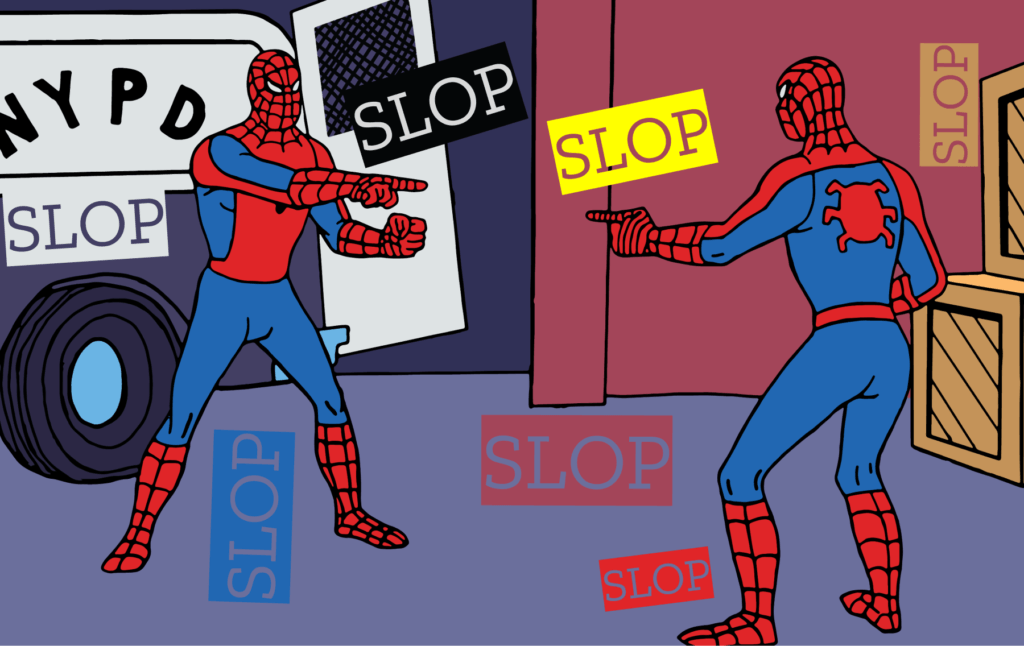
The result is what I think of as the slopification of everything.
This isn’t just about marketing. Software has become increasingly interchangeable. Swap the logo, and most SaaS products are impossible to tell apart. Brand identities are converging because the same prompts produce the same visual language. Sales emails sound interchangeable because they’re all trained on the same playbooks. Even presentations, once reflections of how a company thought, increasingly feel like variations on the same template.
Ironically, the average quality of work has improved while the overall experience has become less memorable. Ten years ago, you would regularly come across terrible websites or painfully bad presentations. Today those obvious failures are becoming rarer.
Better Than Before. Harder to Remember.
When everyone can produce work that’s eight out of ten, then eight out of ten is no longer an advantage. Competence becomes the baseline, not the differentiator. The companies that stand out won’t be those producing the most assets. They’ll be the ones making better decisions about what deserves to exist in the first place.
That’s why I think we’re entering an era where judgment matters more than production.
For years, creative industries rewarded execution. If you could design faster, code better, animate smoother, or write more efficiently, you had an edge. Those skills still matter, but they’re no longer scarce. Scarcity has shifted upstream. The difficult part isn’t making something anymore; it’s deciding what to make, what to ignore, and how to create something people will actually remember.
That’s a much harder problem, and it’s one AI doesn’t solve.
Ask an AI to generate ten landing pages, and it will happily do it. Ask it which one best reflects your company’s strategy, resonates with your customers, and deserves to become the face of your business, and the answers quickly become contradictory.
We’re already seeing a pattern emerge. Clients won’t pay a premium for deliverables anyone can generate. They’ll pay for teams that know what to build, what to ignore, and when to challenge the obvious answer.
The cost of execution is collapsing.
Taste isn’t.
Trust isn’t.
Those are becoming the new premium.
In a world flooded with content, being selective becomes a competitive advantage.