
 Drift: Building the Foundation of a Unicorn Brand
 Metadata: Building The Next Unicorn Brand
 Goodtime: Completely Brand Overhaul in 3 months
 Privy.com: Brand Makeover
 Client Reactions
Choosing the Model That Actually Supports Growth
Most marketing teams come to us asking for a project. A landing page, a sales deck, a campaign launch. That is usually the right starting point.
Where things get interesting is what happens next.
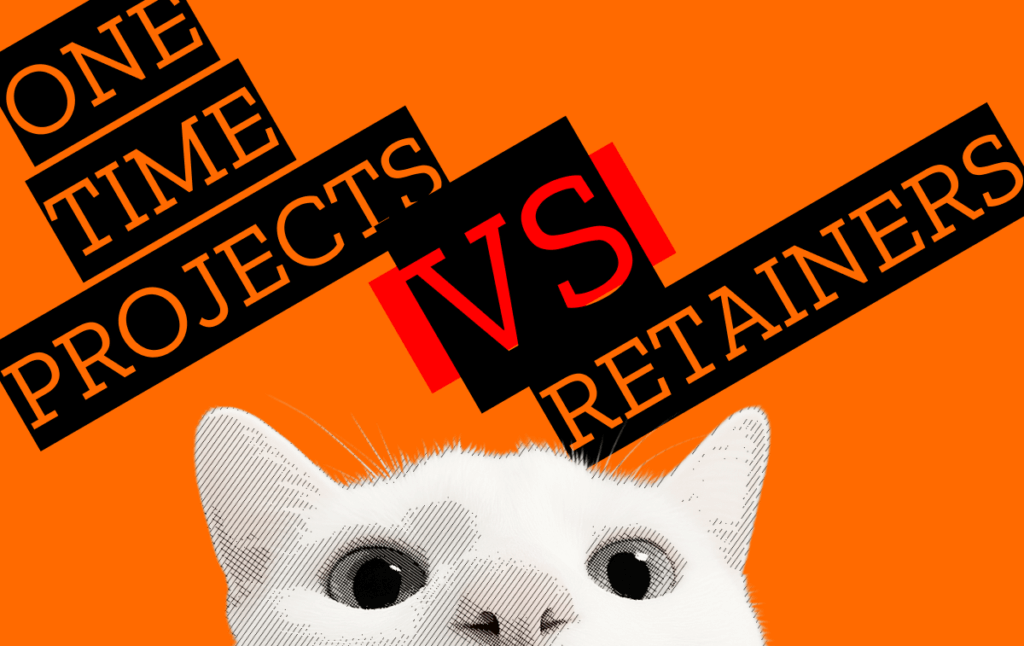
As companies grow, design stops being something they occasionally need and starts becoming part of how the business operates day to day. That is usually the moment the project model begins to show its limits.
This is also when teams often try to optimize for cost by hiring different contractors for different needs. A strategy that almost always backfires. On paper, it looks efficient. In practice, it usually creates more work. Every new contractor needs context, onboarding, brand guidance, and close management. Consistency slips, timelines stretch, and internal teams spend more time coordinating than moving forward.
What feels like a cost saving decision quickly turns into a productivity tax.
Where One Time Projects Start to Break
One time projects work well when the work is contained. There is a clear scope, a fixed timeline, and a specific outcome everyone agrees on.
They start to break down when design becomes recurring. Marketing campaigns are always running. Sales materials are constantly being updated. Messaging evolves. Websites need ongoing changes. Deadlines shift. Small changes become frequent.
At that point, every new request introduces friction. More briefs, more estimates, more conversations about what is in or out of scope. The overhead grows faster than the work itself.
Instead of design helping marketing teams move faster, it becomes something they have to manage carefully.
Why Retainers Create More Leverage
A retainer is about removing friction and building momentum.
In our experience, retainers work best because they allow our design and development teams to become an extension of the client’s marketing team. We develop a deep understanding of the product, the brand, the audience, and how the team actually operates.
That shared context compounds over time. Decisions get made faster. Work moves forward without constant re explanation. Design becomes a dependable part of the system instead of a recurring interruption.
What clients gain is predictable capacity, clearer expectations, and a long term creative partner who is aligned with how the business works, not just how it looks.
When a Retainer Is the Wrong Choice
Retainers are not always the answer. If design is truly occasional, if the work is well defined and infrequent, or if you prefer to manage work one request at a time, a project based model can be the better fit.
The mistake is applying the wrong model to the problem. Projects break under ongoing demand. Retainers feel inefficient when the work is sporadic.
How We Approach It at Algert
We work with both models, but we do our best work on retainers.
Projects are ideal for foundational work with clear boundaries and fixed timelines. Retainers allow us to fully integrate with marketing teams, move faster together, and deliver the highest long term impact.
Our goal is not to sell a model. It is to work in a way that removes friction and maximizes value.
If you need help figuring out which model actually makes sense for your team, we are happy to talk it through. No pitch, no pressure. Just a quick, honest conversation.